
Hair Care Routine for Damaged and Weak Hair
Damaged and weak hair can look dry, rough, dull, and lifeless. You may also notice split ends, frizz, and frequent breakage while combing. Heat styling,...


Category:Hair Color
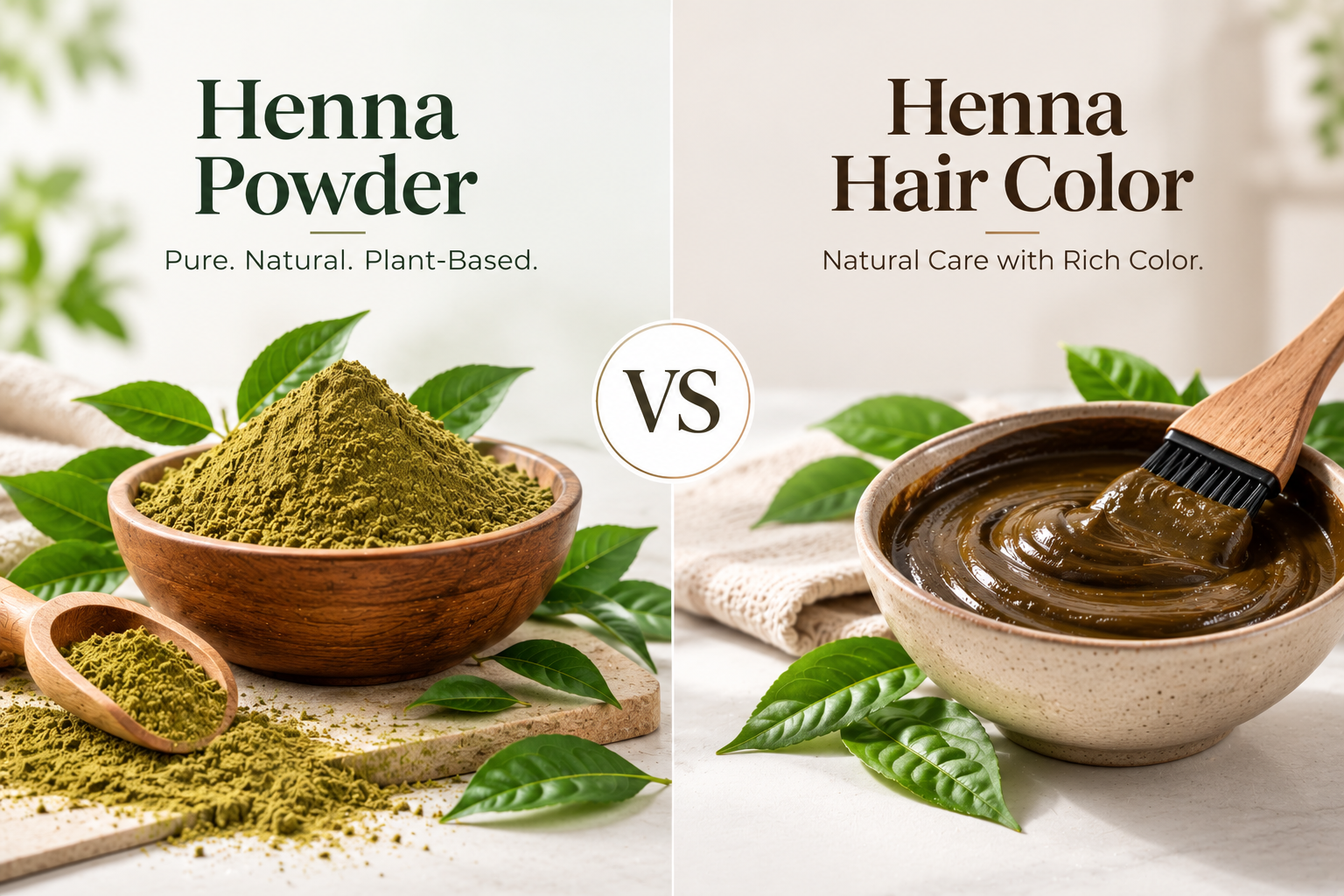
Henna powder vs henna hair color—which should you choose?
Henna powder is generally chosen for traditional plant-based coloring and conditioning, while formulated henna hair color is designed to provide more specific shades and predictable grey coverage. Pure henna naturally produces warm reddish-brown or copper tones, whereas formulated henna-based hair colors can offer shades such as Natural Black, Original Black, Dark Brown, Natural Brown and Burgundy Red.
The right choice depends on whether your priority is traditional henna, a specific hair shade, grey coverage, processing time or convenience.
What Is Henna Powder?
Henna powder is traditionally made from dried and finely ground leaves of the henna plant, Lawsonia inermis.
When mixed with water into a paste and applied to the hair, henna’s natural pigment interacts with the hair and produces its characteristic color.
Traditional henna is widely known as mehendi in India.
Yuthika Natural’s Neeta henna range includes products based on cultivated henna. Its Neeta Herbal Based Hair Color, for example, is made using henna cultivated near Sojat, Rajasthan, and is prepared from processed henna leaves along with selected herbs.
Henna powder may be considered by people who want:
What Is Henna Hair Color?
Henna hair color usually refers to a formulated hair-color product that uses henna as an important part of the formulation.
Unlike traditional henna powder, formulated henna-based hair colors can be developed to provide specific shades and targeted grey coverage.
For example, Nisha Natural Henna Based Hair Color is available in multiple shades, including:
The formulation also features ingredients such as Amla, Shikakai, Aloe Vera and Hibiscus.
This makes formulated henna hair color useful for people who like henna-based formulations but want more control over their final shade.
What Is the Main Difference Between Henna Powder and Henna Hair Color?
The main difference in the henna powder vs henna hair color comparison is the intended coloring result.
Henna powder relies primarily on the natural coloring properties of henna and typically produces characteristic warm henna tones.
Henna hair color is a formulated coloring product that incorporates henna while being designed to deliver particular shades such as black, brown or burgundy.
Here is a quick comparison:
| Feature | Henna Powder | Henna Hair Color |
| Main purpose | Traditional natural coloring and conditioning | Defined hair-color results and grey coverage |
| Color result | Characteristic henna tones | Predetermined shades depending on product |
| Shade options | Naturally limited | Multiple shades may be available |
| Grey hair | Can visibly color grey hair | Products may be specifically designed for grey coverage |
| Preparation | Usually powder + water | Depends on individual formulation |
| Processing time | Often longer | Can be shorter depending on product |
| Best for | Traditional henna users | Users wanting specific shades and grey coverage |
The exact formulation and application process always depend on the individual product.
Is Henna Powder the Same as Henna Hair Color?
No. The terms should not automatically be treated as interchangeable.
Pure henna powder is primarily derived from henna leaves.
A henna-based hair color is a formulated coloring product that uses henna as part of a broader formulation.
This distinction matters because their:
can be different.
If a product says “henna-based hair color,” check its complete ingredient list and instructions rather than assuming it is identical to pure henna powder.
What Color Does Pure Henna Give Hair?
Pure henna naturally produces warm color characteristics that can range from orange and copper to reddish-brown depending on the starting hair color and other factors.
The result can be especially noticeable on grey or white hair because those strands have less natural pigment.
On naturally dark hair, henna’s visible effect may be more subtle.
Therefore, someone looking specifically for black or dark brown grey coverage should not assume that pure henna powder alone will produce the same result as a formulated Natural Black or Dark Brown henna-based hair color.
Can Henna Hair Color Make Hair Black or Brown?
Formulated henna-based hair colors can be designed to provide black and brown shades.
For example, Nisha Natural Henna Based Hair Color currently includes:
Natural Black – 1.00
Original Black – 2.00
Dark Brown – 3.00
Brown – 4.00
Natural Brown
Burgundy Red
Neeta Henna Based Hair Color is also available in Natural Black and Natural Brown variants.
This defined shade selection is one of the most important differences between traditional henna powder and formulated henna hair color.
Henna Powder vs Henna Hair Color for Grey Hair: Which Is Better?
If your main objective is predictable grey coverage in a specific black or brown shade, a formulated henna-based hair color designed for grey coverage may be the more practical choice.
Traditional henna powder can visibly color grey hair, but the result reflects henna’s characteristic natural coloring effect.
Formulated henna-based hair colors can provide shades specifically developed for users who want grey strands to appear black, brown or another defined shade.
For example, Nisha Natural Henna Based Hair Color is positioned for complete grey coverage from roots to tips.
Neeta Henna Based Hair Color is similarly designed to conceal grey hair and is available in Natural Black and Natural Brown.
Therefore:
Choose henna powder if you prefer traditional henna coloring and accept its natural color characteristics.
Choose formulated henna hair color if you want grey coverage in a more clearly defined shade.
Does Henna Powder Cover Grey Hair?
Yes, henna can visibly color grey and white strands.
However, “covering grey” does not necessarily mean turning grey hair black or dark brown.
Pure henna’s natural pigment produces its characteristic warm result.
This distinction is important because consumers sometimes expect traditional henna powder to behave like a conventional black or brown hair-color formulation.
If you want a specific Natural Black, Original Black or Dark Brown result, consider a formulated henna-based hair color designed for that shade.
Which Is Better for 100% Grey Hair?
For predominantly grey or white hair, the desired final shade becomes especially important.
If you are comfortable with the characteristic tones of traditional henna, henna powder may be suitable.
If your goal is a more defined black or brown appearance, a formulated henna-based hair color specifically designed for complete grey coverage may be more appropriate.
Nisha Natural Henna Based Hair Color and Neeta Henna Based Hair Color are examples of products positioned specifically for complete grey coverage.
Individual results can still vary according to:
Henna Powder vs Henna Hair Color: Which Has More Shades?
Henna hair color generally provides more defined shade options.
Pure henna naturally has its own characteristic coloring effect. It does not naturally provide a conventional shade palette covering Natural Black, Dark Brown, Burgundy and similar predetermined colors.
Formulated henna hair colors can.
For example, the Nisha Natural Henna Based Hair Color range currently provides six shade options ranging from Natural Black to Burgundy Red.
Therefore, if shade choice is important, formulated henna hair color generally offers more flexibility.
Is Henna Hair Color the Same as Chemical Hair Dye?
Not necessarily.
“Henna-based” describes the formulation’s relationship to henna. It does not by itself tell you everything else that is present in the product.
Similarly, terms such as:
should not automatically be interpreted as meaning exactly the same thing.
For example, an ammonia-free product means that ammonia is not used in that formulation. It does not automatically mean that the product contains no other chemical or synthetic ingredients.
Always read the complete ingredient declaration and product instructions when choosing a hair color.
Is Henna Hair Color the Same as Pure Henna?
No.
This is one of the most important answers in the henna powder vs henna hair color discussion.
Pure henna primarily refers to powdered henna leaves.
Henna-based hair color refers to a formulated coloring product in which henna is an important component or coloring base.
A henna-based hair color may also contain other herbal ingredients and formulation components designed to achieve a particular color result.
Therefore, consumers should not assume that every product containing the word “henna” is pure henna powder.
Which Is More Natural: Henna Powder or Henna Hair Color?
If by “natural” you mean a product based primarily on powdered henna leaves, pure henna powder is the more straightforward choice.
For example, Yuthika Natural describes Neeta’s henna products as being prepared from natural henna leaves cultivated around Sojat, Rajasthan.
Formulated henna hair color has a different purpose: combining henna-based coloring with the convenience and shade control of a formulated hair-color product.
The better choice depends on what you want from the product rather than whether one category is universally “better.”
What Is Neeta Henna Powder?
Neeta’s henna range represents the traditional side of the comparison.
Yuthika Natural describes its henna as being cultivated using henna leaves from around Sojat in Rajasthan, an area closely associated with henna cultivation.
The Neeta henna portfolio includes products such as Pure Henna Powder, 100% Natural Mehendi Powder and Herbal Based Hair Color.
Selected formulations also incorporate herbs such as:
These products can appeal to people looking for a traditional henna-oriented hair-coloring and conditioning experience.
What Is Nisha Natural Henna Based Hair Color?
Nisha Natural Henna Based Hair Color represents the formulated hair-color side of the comparison.
It is designed to combine henna with a more defined hair-coloring result.
The range is currently available in:
It is positioned for complete grey coverage and includes herbal ingredients such as Amla, Shikakai, Aloe Vera and Hibiscus.
The product is supplied in powder form, mixed with water into a paste and applied with a brush.
This is an important point:
A product being in powder form does not automatically make it pure henna powder.
Both traditional henna and formulated henna hair color can come as powders. Their formulation and intended results are what distinguish them.
What Is Neeta Henna Based Hair Color?
Neeta also offers formulated Henna Based Hair Color in addition to its traditional henna products.
Neeta Henna Based Hair Color is currently available in shades including Natural Black and Natural Brown.
It features Henna along with Amla, Shikakai, Hibiscus and Aloe Vera and is positioned for grey coverage.
This demonstrates why consumers should look at the exact product name and formulation rather than relying on the brand name alone.
A single brand can offer both traditional henna products and formulated henna-based hair colors.
Does Henna Powder Take Longer Than Henna Hair Color?
Traditional henna can require a longer preparation and application process than some formulated henna-based hair colors.
For example, Yuthika Natural’s current instructions for Neeta Herbal Based Hair Color involve preparing the henna paste, allowing it to rest for at least one hour, applying it from roots to tips and keeping it on the hair for approximately three to four hours.
By comparison, Nisha Natural Henna Based Hair Color specifies approximately 30 minutes for Natural Black, Original Black, Brown and Dark Brown, and approximately 60 minutes for Burgundy Red and Natural Brown.
Therefore, a formulated henna hair color can be more convenient for people who want a shorter coloring routine.
Always follow the instructions for the exact product rather than applying these timings universally.
How Do You Apply Henna Powder?
Application varies by product, but traditional henna powder generally follows a process such as:
Do not assume that every henna powder requires the same resting or processing time.
Follow the instructions supplied with the individual product.
How Do You Apply Henna Hair Color?
Formulated henna hair color may have a simpler or shorter process.
For Nisha Natural Henna Based Hair Color, the current directions include:
Other henna-based hair colors may have different instructions.
Always use the directions provided with your exact product.
Henna Powder vs Henna Hair Color for Men
Both can be used by men when the individual product is suitable.
Traditional henna powder may appeal to men who prefer a classic henna application.
Formulated henna-based hair color may be more practical for men who want:
Natural Black and Dark Brown can be particularly relevant when the objective is to blend grey strands with naturally dark hair.
Henna Powder vs Henna Hair Color for Women
Women can similarly choose according to their desired result rather than gender.
Henna powder may appeal to those who prefer traditional henna coloring and conditioning.
Henna-based hair color can provide additional flexibility when the desired result is:
Hair length, density, existing color and percentage of grey hair can all influence the final result.
Which Is Easier to Use at Home?
Formulated henna-based hair color can be more convenient when the product is designed with a straightforward mix-and-apply process and shorter processing time.
Traditional henna powder may involve:
Some users enjoy this traditional process, while others prefer a faster routine.
Therefore, ease of use is partly a matter of personal preference.
Henna Powder vs Henna Hair Color: Which Should You Choose?
The answer depends on your priorities.
Choose Henna Powder If:
Choose Henna Hair Color If:
Neither category is universally better.
The best choice is the one that matches your desired shade, grey-coverage needs, ingredient preferences and application routine.
Henna Powder vs Henna Hair Color: Quick Decision Guide
| If You Want… | Consider |
| Traditional henna experience | Henna powder |
| Characteristic natural henna tone | Henna powder |
| Defined Natural Black shade | Henna hair color |
| Defined Dark Brown shade | Henna hair color |
| Specific grey-coverage product | Henna hair color |
| More shade options | Henna hair color |
| Traditional longer henna routine | Henna powder |
| Potentially faster processing | Formulated henna hair color |
| Plant-based henna-focused product | Check pure henna powder ingredients |
| Henna + defined shade | Formulated henna hair color |
Frequently Asked Questions About Henna Powder vs Henna Hair Color
What is the difference between henna powder and henna hair color?
Henna powder is generally made primarily from powdered henna leaves and produces henna’s characteristic natural color. Henna hair color is a formulated product containing henna that can be designed to provide specific shades such as Natural Black, Dark Brown or Natural Brown.
Is henna powder the same as henna hair color?
No. Although both can contain henna and both may be sold in powder form, their formulations and intended coloring results can be different.
Which is better for grey hair: henna powder or henna hair color?
If you want traditional henna tones, henna powder can color visible grey hair. If you want defined black or brown grey coverage, a formulated henna-based hair color designed for grey coverage may be more suitable.
Can pure henna make grey hair black?
Pure henna should not be expected to produce the same black result as a formulated Natural Black hair color. Pure henna has its own characteristic warm coloring effect.
Can henna hair color cover grey hair?
Yes. Formulated henna-based hair colors can be specifically designed for grey coverage. Nisha Natural Henna Based Hair Color and Neeta Henna Based Hair Color are examples of products positioned for grey coverage.
Which henna is best for natural-looking black hair?
If your desired result is specifically Natural Black, choose a formulated henna-based hair color that offers Natural Black rather than assuming traditional pure henna will produce black hair.
Does henna hair color contain pure henna?
The formulation varies by product. A henna-based hair color contains henna as part of its formulation, but it should not automatically be assumed to contain only pure henna. Check the complete ingredient information.
Is henna-based hair color chemical-free?
Not necessarily. “Henna-based” describes the use of henna in the formulation; it does not automatically mean that no other chemical or synthetic ingredients are present. Check the ingredient declaration rather than relying solely on the term “henna-based.”
Is ammonia-free henna hair color the same as pure henna?
No. Ammonia-free simply means that ammonia is not used in that formulation. It does not mean the product is identical to pure henna powder.
Which has more shades: henna powder or henna hair color?
Formulated henna hair color generally offers more predetermined shade options. Traditional pure henna has its characteristic natural coloring effect, while formulated ranges can offer Natural Black, Original Black, Dark Brown, Brown, Natural Brown and Burgundy Red.
Which is faster: henna powder or henna hair color?
It depends on the individual product, but formulated henna-based hair color can offer shorter processing times. Traditional henna products may require longer preparation and processing.
Can men and women use henna hair color?
Yes. Henna and henna-based hair-color products suitable for both men and women are available. Always check the instructions and intended use of the individual product.
Conclusion: Henna Powder or Henna Hair Color?
When comparing henna powder vs henna hair color, the biggest difference is the type of coloring experience and result you want.
Henna powder is the more traditional option. It is suited to people who want a henna-focused, plant-based coloring experience and are comfortable with the characteristic natural tones of henna.
Henna hair color is a formulated coloring option. It is better suited to people who want henna as part of their hair-color routine while also looking for specific shades, targeted grey coverage and potentially faster application.
Yuthika Natural’s portfolio reflects both approaches. Neeta offers traditional henna-oriented products, while Nisha and Neeta also provide formulated henna-based hair colors for specific shades and grey-coverage needs.
So, there is no universal winner in the henna powder vs henna hair color comparison.
Choose henna powder for a traditional henna experience and choose henna-based hair color when defined shades and grey coverage are your priorities.
Whichever you choose, read the complete ingredient information and application instructions, perform any recommended allergy alert test, and follow the specified preparation and processing time for the exact product.
Damaged and weak hair can look dry, rough, dull, and lifeless. You may also notice split ends, frizz, and frequent breakage while combing. Heat styling,...
Dry and rough hair can look dull, feel coarse, and become difficult to manage. Factors such as heat styling, frequent washing, harsh hair products, sun...
Indian hair is exposed to different challenges, including heat, humidity, pollution, hard water and changing weather. These factors can make hair dry, frizzy, dull or...